
Most of us are taught to fear failure from a young age. We watch our parents scold us for mistakes, we watch our classmates make fun of us for wrong answers, and then we grow up believing that failing means we’re not good enough. But what if everything we’ve come to believe about failure turns out to be wrong?
Your **perspective on failure** shapes whether you’ll take risks, chase dreams, or play it safe forever. The stories you’re about to read aren’t just feel-good tales—they’re mirrors reflecting a truth most people miss: failure isn’t the opposite of success. It’s the raw material success is built from.
Let’s explore three powerful stories that will fundamentally shift how you see setbacks, mistakes, and the stumbles along your journey period.
Story 1: The Elephant and the Rope

Picture a massive elephant standing in a field, one leg casually tied to a wooden stake barely thicker than your wrist. This magnificent creature—strong enough to uproot trees—stands there peacefully, never attempting to break free. Why?
When this elephant was just a baby, trainers tied him to that same stake. Back then, he was too small and weak to break loose. He pulled and struggled, over and over, until exhaustion took over. Eventually, he stopped trying. His young mind learned a devastating lesson: “I cannot break free.”
Years passed. The elephant grew massive and powerful, gaining the physical strength to snap that rope like thread. But he never tried again. The rope that once held him captive was now just a symbol. The real prison existed in his mind—a false belief cemented by early failure.
Think about it this way: the elephant’s physical reality changed completely, but his mental reality stayed frozen in that moment of childhood defeat.
The Failure Lesson
This story cuts deep because we’re all that elephant in some area of our lives.
Maybe you tried starting a business in your twenties and it flopped. Now you’re forty, with more skills, connections, and wisdom, but you won’t try again because of that one failure. Perhaps you auditioned for a play in high school and bombed—now you won’t even do karaoke with friends. That early failure created a rope in your mind.
The elephant teaches us that our **perspective on failure** is often based on outdated information. You’re not the same person who failed before. You’ve grown, learned, and changed. But if you’re still operating from that old story, you’ll remain stuck while having all the power you need to break free.
**Overcoming setbacks** starts with recognizing which “ropes” are still holding you back. Ask yourself: What did I fail at years ago that I now have the skills to succeed at? What childhood or early adult failure am I still letting define my current capabilities?
The rope isn’t real anymore. It’s time to pull.
Story 2: Thomas Edison’s 10,000 Experiments

Everyone knows Thomas Edison invented the light bulb. What most people don’t know is the brutal truth behind that achievement.
Edison didn’t just try a few times and succeed. He conducted roughly 10,000 experiments before creating a commercially viable light bulb. Imagine that for a moment—10,000 attempts. Most people quit after three or four failures, convinced they’re not cut out for whatever they’re trying.
When a reporter asked Edison how it felt to fail 10,000 times, his response revealed a completely different **perspective on failure**: I didn’t fail 10,000 times. I just found 10,000 ways that won’t work.
That single sentence rewrites the entire narrative of failure.
Edison didn’t see setbacks as stop signs. He saw them as data points, each one bringing him closer to the solution. Every material that didn’t work eliminated one possibility and narrowed the path forward. His laboratory wasn’t a place of repeated defeat—it was a place of constant progress, even when nothing seemed to work.
Here’s the real kicker: while Edison was experimenting, countless other inventors gave up. They had similar knowledge, access to materials, and intelligence. The difference wasn’t talent. It was how they interpreted failure.
The Failure Lesson
Edison’s story demolishes the myth that successful people don’t fail. They fail constantly—far more than unsuccessful people. The difference is their **growth mindset** transforms each failure into feedback rather than a final verdict on their abilities.
When you adopt Edison’s perspective, **learning from mistakes** becomes your competitive advantage. Every entrepreneur who quit after their first business failure left the market open for someone with Edison’s mindset. Every writer who abandoned their craft after rejections made room for those who saw rejection as part of the process, not the end of it.
This is especially crucial for **motivation for entrepreneurs** and anyone building something from scratch. Your first product launch might flop. Your initial marketing campaign might get zero response. Your prototype might break. That’s not failure—that’s data. That’s step one of your 10,000-step invention.
The question isn’t whether you’ll fail. You will. The question is whether you’ll count those failures as steps toward success or as reasons to quit.
**Success after failure** isn’t the exception—it’s the rule. But only if you reframe what failure means. Stop asking “Why did I fail?” And then ask yourself: “What did this failure teach me?”
Story 3: The Butterfly Struggling to Emerge
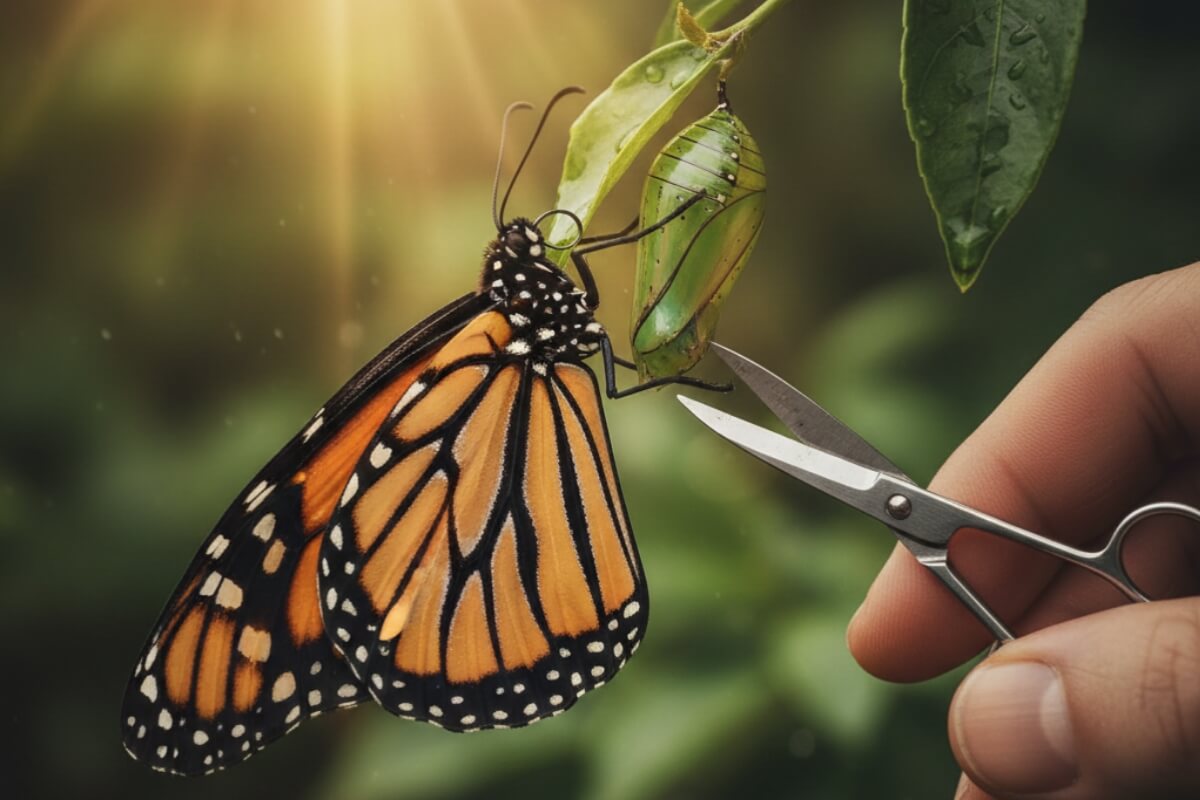
One day a man saw a cocoon hanging from a tree branch. Fascinated, he watched as a small opening appeared and a butterfly began to struggle, pushing itself through the tiny hole. Hours passed. The butterfly fought and strained, making painfully slow progress.
The man’s heart went out to the struggling creature. Wanting to help, he grabbed scissors and carefully snipped the cocoon, giving the butterfly an easier way out. The butterfly emerged quickly—but something was wrong.
Its body was swollen and its wings were shriveled and weak. The man expected the wings to expand, allowing the butterfly to fly away. But it never happened. The butterfly spent the rest of its short life crawling on the ground, never able to fly.
What the man didn’t understand was that the struggle to break free from the cocoon wasn’t cruel—it was necessary. That fight forces fluid from the butterfly’s body into its wings, making them strong enough for flight. By eliminating the struggle, the man eliminated the butterfly’s chance to develop properly.
The compassionate act of removing the obstacle became the cruelest thing he could have done.
The Failure Lesson
It’s a tough pill to swallow, but the struggles you’re facing right now might be exactly what you need to develop the strength for what’s coming next.
We live in a culture that wants to eliminate all discomfort and struggle. We search for hacks, shortcuts, and easy paths. When things get hard, we assume something’s wrong or we’re on the wrong path. But what if the difficulty is the path?
This story completely shifts your **perspective on failure** by revealing that some “failures” aren’t failures at all—they’re training. That job you didn’t get might be preparing you for a better opportunity you’re not yet ready for. That relationship that ended might be teaching you boundaries you’ll need in your next partnership. That business that struggled might be building the resilience you’ll need when you finally scale.
The butterfly story teaches us that **overcoming setbacks** isn’t about avoiding struggle—it’s about recognizing that struggle itself has value. When you’re in the middle of a difficult period, fighting against obstacles that seem insurmountable, remember: you’re not trapped in the cocoon. You’re developing the wings you’ll need to fly.
This doesn’t mean every struggle leads to success or that you should stay in genuinely harmful situations. It means before you quit or take the easy way out, ask yourself: “Is this struggle building something in me that I’ll need later?”
How to Bounce Back When You Fail
Understanding failure philosophically is one thing. Actually dealing with it when you’re face-down in defeat is another. Here are practical strategies to shift your **perspective on failure** in real-time:
**Separate the failure from your identity.** You failed at something; you are not a failure. The elephant in the first story couldn’t make this distinction, so he let one defeat define his entire existence. Don’t do that. Your business failed—you’re not a failed person. Your relationship ended—you’re not unlovable. The distinction matters.
**Document what you learned.** Edison kept detailed notes on every experiment. When you fail, write down specifically what went wrong and what you learned. This transforms vague feelings of defeat into concrete knowledge. Six months later, when you’re ready to try again, you’ll have a manual of what not to do.
**Find the pattern in your setbacks.** Do you quit right before breakthroughs? Do you sabotage yourself when things go well? Do you choose the wrong partners? **Learning from mistakes** requires seeing the patterns, not just the individual events.
**Surround yourself with people who’ve failed up.** If everyone around you plays it safe and judges failure harshly, you’ll stay stuck. Find communities—online or in person—where people share their failures openly and celebrate the courage to try. Your **growth mindset** won’t survive in a fixed-mindset environment.
**Set a “failure quota.”** This sounds strange, but try it. Tell yourself, “I need to fail at least five times this month trying new things.” This reframes failure as a sign you’re pushing boundaries rather than a sign you’re inadequate. Many successful entrepreneurs deliberately seek out failures as proof they’re taking enough risks.

A Final Thought That Changes Everything
These three stories—the elephant, Edison, and the butterfly—share a common thread. They all reveal that failure isn’t what we think it is.
The elephant shows us that past failures create false limits in our minds. Edison proves that massive failure is often the path to massive success. The butterfly demonstrates that struggle itself can be the mechanism of growth.
Your **perspective on failure** will determine whether you live a bold, expansive life or a cautious, limited one. Most people will read these stories, feel inspired for a day, then return to their old patterns because changing your relationship with failure requires more than inspiration—it requires practice.
Every single day, you’ll face small moments where you can either let fear of failure stop you or push forward anyway. The person who sends that cold email to a potential mentor. The entrepreneur who launches despite imperfect preparation. The artist who shares work that might get criticized. These people aren’t fearless—they’ve just reframed what failure means.
Here’s what I want you to remember: you are not the elephant. You have the power to break free from old stories. You can adopt Edison’s mindset and see your setbacks as steps. You can trust that your current struggle, like the butterfly’s, is making you stronger.
The real failure isn’t trying and falling short. The real failure is never trying because you’re afraid of falling short. **Success after failure** isn’t just possible—it’s the only way success actually happens.
So go ahead. Pull against that rope. Conduct your next experiment. Keep struggling through that cocoon. Your perspective on failure isn’t just a mindset—it’s the key to everything you want to build.

I’m Maqbool Ahmed, the founder of Brainy Vibes. My mission is to help people reach their true potential through inspiring insights, success strategies, and powerful habits.